
You’re spending money on advertising. Prospective students are visiting your website, requesting information, and asking about programs.
Everything seems to be working.
But when you look at actual enrollments, the numbers tell a different story.
Where did all those interested students go?
The problem might not be your advertising. It could be what happens after someone clicks.
Before increasing your marketing budget, take a closer look at the steps between that first visit and enrollment. You may discover opportunities to improve results without attracting a single additional visitor.
Understand Where Prospective
Students Drop Off
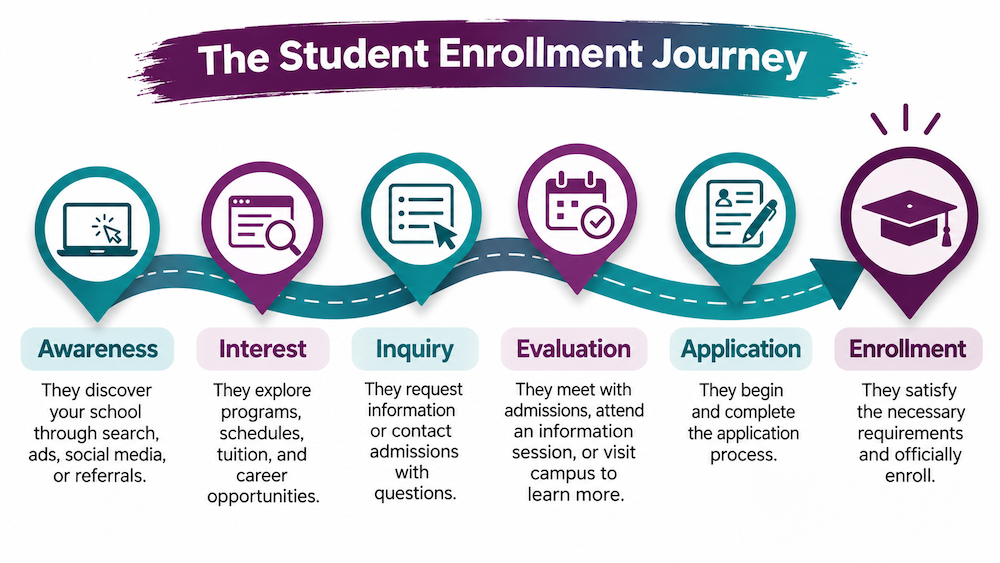
Think about the typical journey someone takes before enrolling at your school:
- Awareness: They discover your school through search, advertising, social media, or referrals.
- Interest: They explore programs, schedules, tuition, and career opportunities.
- Inquiry: They request information or contact admissions.
- Evaluation: They speak with an admissions representative, attend an information session, or visit campus.
- Application: They begin and complete the application process.
- Enrollment: They satisfy the necessary requirements and officially enroll.
Not everyone follows this exact sequence. Some students apply without visiting campus, while others contact admissions several times before making a decision.
The important question is whether your school understands what happens between these stages.
Five Places Your Enrollment Funnel
May Be Losing Students
1. Website Visitors Aren’t Requesting Information
Someone clicks your advertisement, arrives on a program page, and leaves without contacting you.
Why?
Maybe the tuition information is difficult to find. Perhaps the program page doesn’t explain career opportunities clearly. Or the inquiry form asks for more information than visitors are comfortable providing.
Start by reviewing your website on a mobile phone.
Can prospective students quickly find program details, schedules, costs, and a clear next step?
Try simplifying inquiry forms and making contact options easy to find. Then measure whether more visitors complete an inquiry.
2. Inquiries Aren’t Turning Into Conversations
A prospective student requests information on Monday. Your admissions team responds on Thursday.
By then, that person may already be speaking with another school.
Review how quickly your team responds and whether inquiries receive useful, personalized information.
An automated acknowledgment can confirm that a request was received, but it shouldn’t replace meaningful follow-up.
Use the communication methods students have agreed to, and make it easy for them to ask questions or schedule a conversation.
3. Interested Students Aren’t Taking the Next Step
You’ve connected with a prospective student, but they haven’t scheduled an admissions appointment.
Before assuming they’ve lost interest, consider what might be holding them back.
Do they understand what happens during the appointment? Can they schedule online? Are evening appointments available?
A short video introducing your admissions team and explaining what to expect could make that next step feel less intimidating.
For students balancing work and family responsibilities, virtual appointments may also be helpful.
4. Campus Visits Aren’t Leading to Applications
A prospective student tours your facilities, meets instructors, and seems genuinely interested.
Then nothing happens.
Sometimes the problem is an unanswered question about tuition, financial aid, scheduling, or admission requirements.
Before the visit ends, make sure the student understands the application process and knows whom to contact for assistance.
Offer help getting started, but give them room to make an informed decision.
Follow up afterward with information relevant to their concerns rather than another generic enrollment reminder.
5. Applications Aren’t Becoming Enrollments
An application isn’t the finish line.
Students may still need to submit documentation, complete financial aid requirements, arrange transportation, or resolve scheduling conflicts.
A simple enrollment checklist can make a significant difference.
Show applicants which requirements they’ve completed, what’s outstanding, and where to get help.
Consider assigning a consistent admissions contact who can answer questions throughout the process.

Find Your Biggest Enrollment Bottleneck
Here’s where the strategy gets interesting.
Instead of guessing which part of your enrollment process needs attention, look at your actual numbers.
Gather data from your website analytics, inquiry forms, admissions records, and enrollment system.
For a defined period, review:
- Website visitors and inquiries
- Inquiries successfully contacted
- Admissions appointments scheduled and completed
- Applications started and submitted
- Applicants who officially enrolled
Calculate the percentage moving from one stage to the next, using consistent definitions and time periods.
But don’t stop at the numbers.
Talk with your admissions team. Ask prospective students about difficulties they’ve encountered. Review common questions and incomplete applications.
You might discover that your biggest problem isn’t attracting students. It’s that applicants don’t understand the financial aid process, or that working adults can’t schedule admissions appointments during business hours.
Those insights are far more useful than simply deciding you need more leads.
Fix the Process Before Increasing
Your Advertising Budget
More website traffic won’t automatically solve an enrollment problem.
If prospective students are struggling to find information, connect with admissions, or complete applications, additional advertising may simply send more people into the same frustrating experience.
Start with one improvement.
Simplify a form. Clarify an application requirement. Improve follow-up. Make appointment scheduling easier.
Measure what changes before moving to the next issue.
At Six Degrees Digital Media, we look beyond individual marketing campaigns to identify opportunities that may be affecting the bigger picture.
If your school is generating interest but struggling to turn that interest into enrollments, Schedule a call. Let’s explore where your enrollment marketing could be working harder for you.